Amy Hide · Mary Lamb—Baby(Lucinda Bunting)
Other PeopleThe relationship between Amy Hide and Baby (Lucinda Bunting) is renewed in a reunion that is immediate in feeling but incomplete in knowledge. Baby had believed Amy dead; Amy is alive, changed, and unable to remember her past with certainty. Their embrace restores the fact of sisterhood before it restores any shared account of what happened, making their affection a form of recognition that does not depend on recovered memory.
The reunion
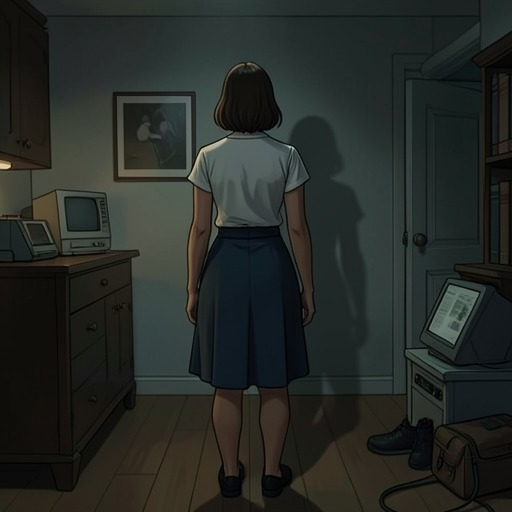
Baby arrives at the house after Amy sees her shape behind the rippled glass and chooses not to hesitate. When Amy opens the door, her heart seems to be everywhere at once, and the two women embrace. The bodily immediacy of the meeting precedes explanation: neither a recovered history nor a settled identity is needed for Amy and Baby to find one another in that moment.
Baby is astonished by Amy’s appearance and says that she looks younger than Baby. She also recalls the Amy she knew as having a sullen, challenging, bored look, and tells her that she was awful. The reunion therefore includes recognition and estrangement together. Baby identifies a former manner that Amy cannot confirm from memory, while the living woman before her seems different enough to make the return feel startling. When Baby says she thought Amy was dead, Amy asks her not to say so, fearing that she will start crying. Their shared past is emotionally present even though Amy cannot yet retrieve it as a reliable personal history.
Memory and identity
Amy is candid about the limit of her knowledge: she still cannot remember anything for certain. Baby does not resolve that uncertainty or supply a complete account of Amy’s past. Instead, the sisters meet within the gap between Baby’s recognition and Amy’s amnesia. Baby can speak from the relationship they had, including her impression of Amy’s old expression; Amy can accept the present connection without claiming memories she does not possess.
The uncertainty sharpens near Baby’s departure, when she raises the question of how one can know oneself. Amy answers by asking whether they are twins, and Baby replies that she loves her; Amy returns the declaration. The exchange does not establish that the sisters are twins—in fact, Amy’s question is answered in the negative. Its importance lies in the alternative Baby offers: love can be affirmed between them even where certainty about identity and history remains unavailable. Their reciprocal words give the reunion a present-tense assurance without pretending that Amy’s memory has returned.
Family news and changed circumstances
Amy asks after their father, and Baby reports that he is now completely blind. She also says that Marge and George are wonderful. Baby has not told them about the matter she and Amy understand but leave unspecified; Amy agrees that this is best. The conversation thus re-establishes a family world around the sisters while preserving a deliberate silence within it. They share enough knowledge to make the decision together, even though the nature of the undisclosed matter is not stated in this exchange.
Baby is married and cannot stay long. She presents marriage as ordinary and almost inevitable, like leaving home, rather than as an exceptional event. She tells Amy that her daughter is named Mary, adding that she would call the next one Amy if it were a girl. Amy’s response is that the name is strange; Baby answers that it is common. The names connect the conversation to Amy without making the child a replacement for her: Baby’s daughter is Mary, and the hoped-for future name remains conditional. Baby invites Amy to visit, meet her niece and brother-in-law, and gives her reason to expect another meeting rather than treating this reunion as a final one.
A bond renewed, not completed
Baby says how good it is to have a sister again. The statement makes explicit what the embrace has already enacted: the relationship is not merely recalled as a past fact but reclaimed in the present. They embrace once more before Baby leaves, and Baby promises that Amy’s memories will return in time. Amy watches the car vanish into the evening haze; the scene closes without showing that the promise has been fulfilled. The sisters’ affection is certain, but Amy’s recovery is not.
The phrase Baby uses in that promise echoes words Amy has just encountered on the back of an old execution photograph: John Prince had written “You wait.” Baby’s later “You wait” turns the phrase toward patience and future recognition, linking the unresolved past to the possibility of recovery. It does not offer Amy proof of who she is or an immediate return of memory. Instead, the reunion gives her something more limited and already real: a sister who remembers her, welcomes her back, and expects their connection to continue.